
2500 S. Decker Lake Blvd
West Valley UT, 84119
USA
Medical waste management in the state of Utah falls under the jurisdiction of two primary state agencies: the Utah Department of Environmental Quality (DEQ) and Utah’s Department of Health and Human Services (DHHS). DEQ is primarily responsible for overseeing the handling and disposal of medical waste in Utah. This includes ensuring compliance with state-specific rules and managing permits for facilities that process or dispose of medical waste. DHHS provides guidance on public health concerns related to medical waste and collaborates with the DEQ to ensure that medical waste handling minimizes risks to human health and the environment.
These state-level regulations work in conjunction with federal oversight from OSHA, which manages worker safety and bloodborne pathogen protocols, and the EPA, which provides broader guidelines and regulations under the Resource Conservation and Recovery Act (RCRA).
How Utah Defines “Medical Waste”
In the State of Utah, medical waste is classified under “infectious waste,” which is broadly defined as waste capable of transmitting disease. The specific rules governing “infectious waste” are listed in Rules 315-316 of Utah’s Administrative Code, which apply to any health care facility generating more than 200 pounds of waste per month or any transporter collecting more than 200 pounds of waste per month in any single load.
In an official guidance document explaining how DEQ should interpret the requirements of Rules 315-316, it is noted that the term “infectious waste” “is intended to include waste that is capable of producing an infectious disease.” This waste may include “such materials as used sharps (needles, syringes, blades, pipettes, broken glass, and blood vials), body fluids or materials mixed with body fluids, bandages, or other materials that have come in contact with body fluids.”
Medical Waste Generators in Utah
In Utah, medical waste generators are identified in laws, statutes, and regulations as entities that produce medical waste through the provision of healthcare, research, or related activities. These generators include:
General Requirements
Utah’s regulations call for infectious waste generators subject to the requirements of Rules 315-316 to prepare and file a management plan which identifies the type and estimated quantity of waste generated or handled; segregation, packaging, and labeling procedures; collection, storage, and transportation procedures; treatment or disposal methods that will be used; and the person responsible for the management of the infectious waste.
Storage and Containment Requirements
Rules 315-316 make it mandatory for all generators of infectious waste to abide by the following procedures:
– Infectious waste shall be contained in a manner and location which affords protection from animal intrusion, does not provide a breeding place or a food source for insects or rodents, and minimizes exposure to the public.
– Unless all waste is considered infectious and labeled as such, infectious waste shall be segregated by separate containment from other waste during storage.
– Except for sharps, infectious waste shall be contained in plastic bags or inside rigid containers. The bags shall be securely tied and the containers shall be securely sealed to prevent leakage or expulsion of solid or liquid wastes during storage or handling.
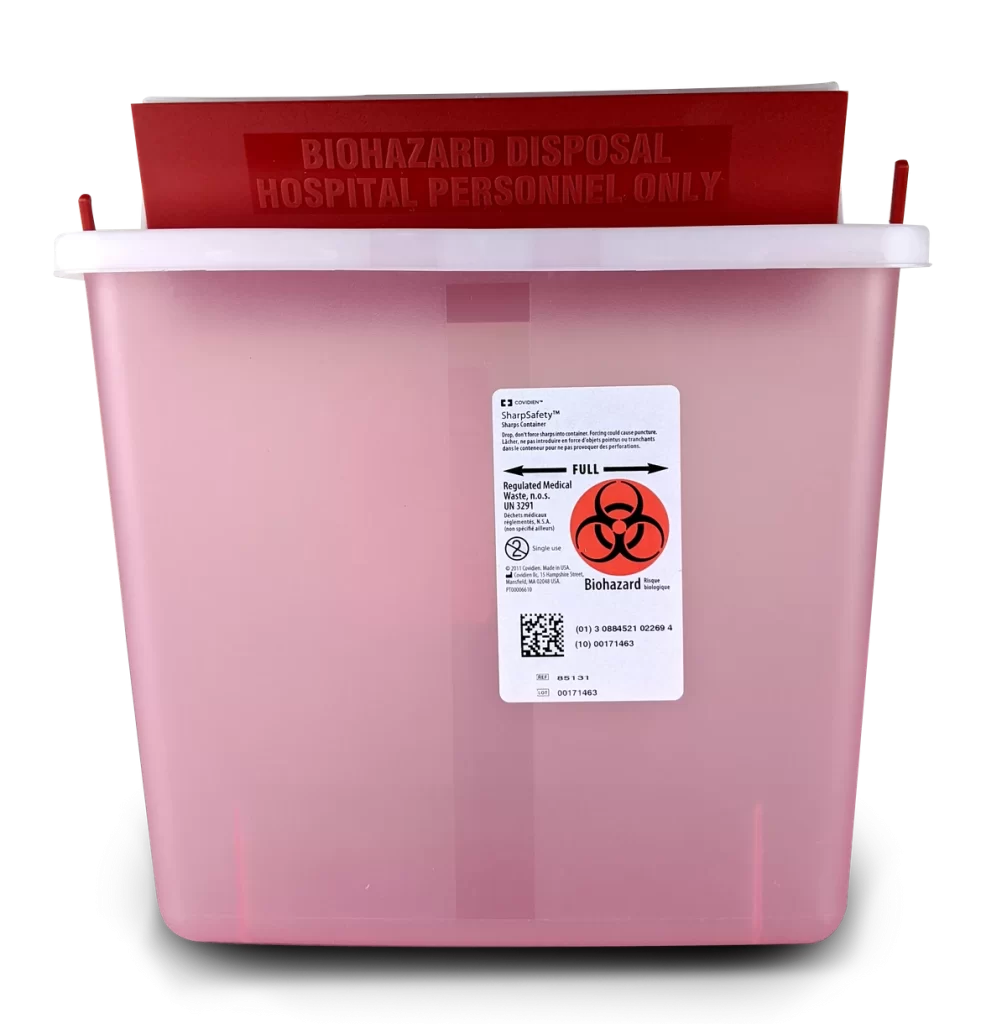
– Sharps shall be contained for storage, transportation, treatment, and disposal in leak-proof, rigid, puncture-resistant containers which are taped closed or tightly lidded to preclude loss of contents.
– All infectious waste containers should be red or orange and shall be clearly identified with the international biohazard sign and one of the following labels: “INFECTIOUS WASTE”, “BIOMEDICAL WASTE”, or “BIOHAZARD”.
– If other waste is placed in the same container as infectious waste, then the generator must package, label, and mark the container and its entire contents as infectious waste.
– A rigid infectious waste container may be reused for infectious or non-infectious waste if it is thoroughly washed and decontaminated each time it is emptied or if the surfaces of the container have been completely protected from contamination by disposable, unpunctured, or undamaged liners, bags, or other devices that are removed with the infectious waste, the surface of the liner has not been damaged or punctured.
– Storage and containment areas shall: protect infectious waste from the elements; be ventilated to the outside atmosphere; be accessible only to authorized persons; and be marked with prominent warning signs on, or adjacent to, the exterior doors or gates. The warning signs shall contain the international biohazard sign and shall state: “CAUTION — INFECTIOUS WASTE STORAGE AREA — UNAUTHORIZED PERSONS KEEP OUT” and must be easily read during daylight from a distance of 25 feet.
– If infectious waste is stored longer than seven days, the infectious waste shall be stored at or below a temperature of 40 degrees Fahrenheit (5 degrees Celsius).
– Under no conditions may infectious waste be stored for longer than 60 days.
– Compactors, grinders, or similar devices shall not be used to reduce the volume of infectious waste unless the device is contained sufficiently to prevent contamination of the surrounding area.
Transportation Regulations
Rule 315-316’s requirements for transporting infectious waste emphasize safety and containment. Infectious waste must be separately enclosed or treated entirely as infectious waste. Workers handling such waste must use protective gear and follow decontamination protocols. Transport vehicles must prevent leaks, secure discharge points, and comply with Department of Transportation biohazard requirements. Additionally, vehicles must carry spill kits, and personnel must be trained in cleanup procedures. Out-of-state waste must adhere to these rules. All surfaces exposed to spills must be decontaminated following approved procedures.
Treatment and Disposal Regulations
Rule 315-316’s requirements for the treatment and disposal of infectious waste mandate timely treatment or disposal at approved facilities using methods like incineration, steam sterilization, or approved alternatives that ensure biological inactivation of harmful organisms. Waste must meet strict standards for decontamination before handling as noninfectious material. Detailed protocols cover sterilization equipment operation, record-keeping, and testing for efficacy. Liquid infectious waste may be discharged to secondary sewage systems if permitted. Landfills accepting infectious waste must follow specific procedures to prevent environmental exposure.
All medical waste generators in Utah must adhere to the above regulations for the handling, storage, treatment, and disposal of medical waste to ensure safety and regulatory compliance.